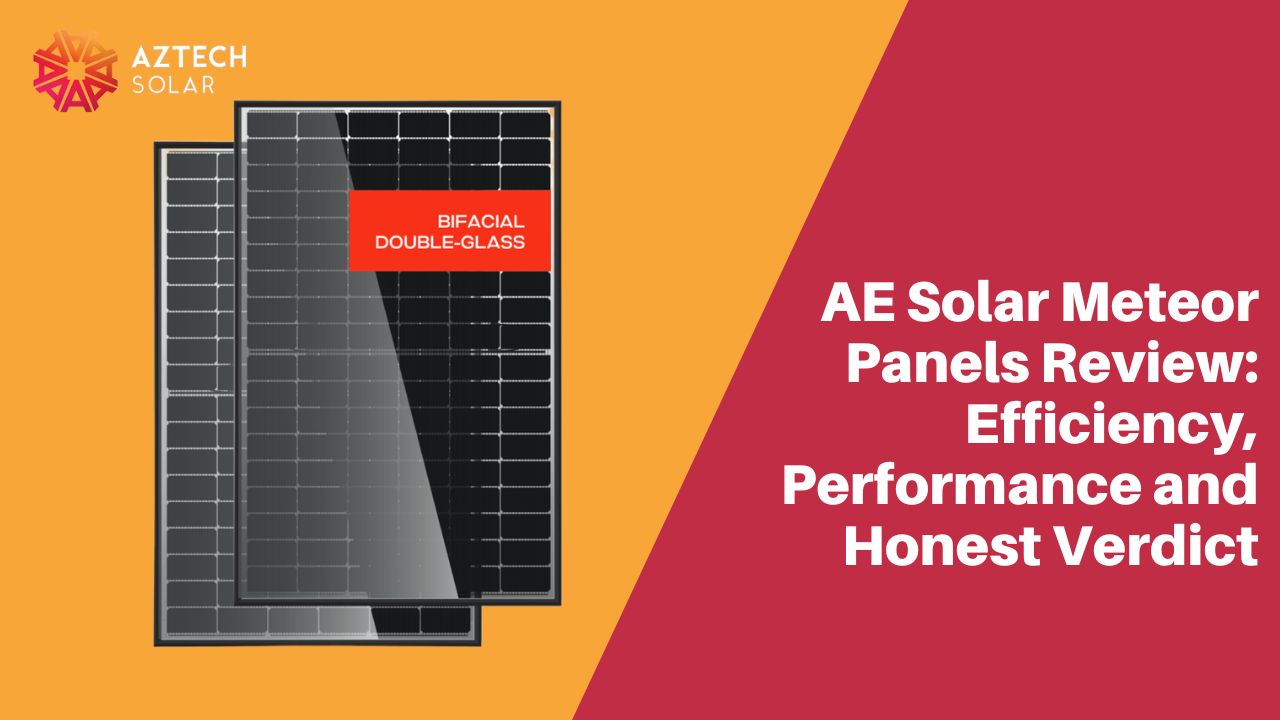
AE Solar Meteor panels are a genuinely good choice for most Australian homes, offering efficiency ratings between 20% and 21.3% and technology designed to hold up in real heat. If you are comparing panels for a Newcastle or Hunter region installation, this review covers what the specs actually mean in practice, where the Meteor Series performs well, and where it sits against the cost of alternatives.
How Efficient Are AE Solar Meteor Panels?
AE Solar Meteor panels achieve module efficiencies of approximately 20% to 21.3% depending on the specific model within the series. In practical terms, a panel rated at 21% efficiency converts 21 cents of every dollar’s worth of sunlight that hits it into usable electricity.
Most quality residential panels available in Australia in 2025 sit between 18% and 22%, so the Meteor Series sits firmly in the upper range of that bracket.
For a homeowner with limited roof space, the difference between a 19% panel and a 21% panel can translate to one or two fewer panels needed to reach the same daily output target, which reduces hardware cost and installation complexity.
You can verify the specific model-by-model efficiency figures against the official AE Solar datasheet library before committing to a particular model.
What Makes Meteor Panels Perform This Way?
Four design features explain most of the Meteor Series performance in real conditions:
Half-cut cell technology splits each cell into two smaller halves. This reduces resistive losses as current travels through the cell and means that shading or soiling on one section of the panel has less impact on the entire panel’s output compared to full-cell designs.
Low temperature coefficient is the technical measure of how much a panel loses output as it heats up. Solar panels lose efficiency in high temperatures, and this is a real issue in Australian summers. AE Solar publishes a temperature coefficient of around -0.30%/C for the Meteor Series, which is competitive for monocrystalline PERC technology.
For comparison, a coefficient of -0.40%/C would mean noticeably steeper performance drops on a 40-degree day.
Hot spot resistance is built into the cell design. Hot spots occur when one cell in a string performs differently from the rest, generating heat rather than electricity. Over time, hot spots degrade panels and can shorten their working life. The Meteor design reduces this risk.
Bifacial options are available on selected models. A bifacial panel captures reflected light from the surface behind it, typically adding a small percentage of additional output. The actual gain depends on the albedo (reflectivity) of the surface beneath the panel and is typically more relevant for ground-mounted or elevated roof installations than for flush-mounted residential roofs.
Are AE Solar Meteor Panels Worth It? Our Verdict
Based on what we see in real installations across Newcastle, Lake Macquarie and the Hunter, the Meteor Series earns a straightforward recommendation for most residential applications. Here is an honest summary:
| Factor | AE Solar Meteor Series | Budget panel benchmark |
|---|---|---|
| Efficiency range | 20% to 21.3% | 17% to 19% |
| Temperature coefficient | Approx. -0.30%/C | Often -0.38% to -0.45%/C |
| Hot spot protection | Yes, cell-level design | Varies by brand and model |
| Bifacial option | Yes, selected models | Rarely available at this tier |
| Country of engineering | Germany | Often unspecified |
| Warranty structure | Confirmed with installer | Varies significantly |
Note: Budget panel figures represent a general market range for illustration. Verify specific competitor specs from their published datasheets before making a direct comparison.
Where they earn the recommendation:
- Roofs with partial shading benefit from the half-cut cell design
- Australian summers mean the low temperature coefficient genuinely matters, not just on paper
- The German engineering origin and established warranty support (nearly two decades as a brand) reduce long-term risk
Where to think carefully:
- If your roof is large and unshaded, a budget panel with adequate efficiency may deliver acceptable returns at lower upfront cost
- Bifacial gains on a standard flush-mounted residential roof are modest and should not be a primary decision driver
- Always confirm the specific warranty terms with your installer before purchase, because warranty coverage can vary by distributor
The Meteor Series is not the cheapest panel available, but for homeowners who want reliable output over a 10 to 15-year horizon, the combination of efficiency, heat performance and quality control is a defensible choice.
The Real Benefits for Homeowners
Put simply, the Meteor Series provides:
- Consistent output across the day, including early morning and late afternoon angles when lower-efficiency panels trail off
- Durability suited to Australian dust, heat and UV exposure
- Fewer panels needed for a given output target, which is worth comparing against a 440W high-output panel if maximising power per panel footprint is your priority
- Reduced risk of the performance degradation that shows up in cheaper panels after three to five years
About AE Solar as a Brand
AE Solar is a brand with German engineering origins and a manufacturing footprint that has expanded significantly over the past two decades. Their panels are designed to meet European quality standards, which is relevant because those standards typically exceed the minimum thresholds required for Australian grid connection.
At Aztech Solar, we have installed AE Solar panels across residential and commercial sites in Newcastle, Lake Macquarie and the Hunter. Our professional opinion, based on that installation experience, is that the Meteor Series performs consistently with its published specifications.
That is not a guarantee of any individual system’s output, which depends on site conditions, inverter matching and installation quality.
Is an AE Solar Meteor Panel Right for Your Roof?
At Aztech Solar, we assess roof size, orientation, shading, energy usage and budget before recommending any panel brand. The Meteor Series suits many situations, but it is not the automatic answer for every home.
If you want a straightforward conversation about whether these panels make sense for your specific setup, call us on 1300 992 922. We are based in Cardiff and work across Newcastle, Lake Macquarie and the Hunter.
Frequently Asked Questions
Are AE Solar Meteor panels good?
Yes, based on published specifications and our installation experience in the Hunter region, AE Solar Meteor panels are a solid performer in the upper-mid tier of the residential solar market. They offer efficiency between 20% and 21.3%, a competitive temperature coefficient for Australian conditions, and design features that reduce common failure points like hot spots.
They are not the cheapest option, but they are a dependable one backed by a manufacturer with close to two decades of operation.
How efficient are AE Solar Meteor panels?
AE Solar Meteor panels achieve module efficiency of approximately 20% to 21.3% depending on the model. This places them in the upper range for monocrystalline residential panels available in Australia. You can confirm the efficiency figure for the specific model you are considering by checking the AE Solar product datasheet for that panel.
Are 440W solar panels worth it?
440W panels, across brands, are considered high-output for residential use. They are particularly useful if your roof space is limited or your household has above-average energy needs, because fewer panels are needed to reach a given system size.
Whether a 440W Meteor panel or another 440W option is the better fit depends on the efficiency, price and warranty of the specific model alongside your roof’s characteristics.
How do I know if my solar panels are working properly?
The most reliable method is your inverter’s monitoring system or the associated app. Check for a green status indicator on the inverter, daily production figures that are consistent with expected output for the season, and no unexplained drops over time.
If you do not have monitoring set up, a meaningful reduction in grid electricity drawn during daylight hours on your bill is a secondary signal. Any persistent drop in output compared to your first year of operation is worth investigating with your installer.
What is the 20% efficiency rule for solar panels?
The 20% figure refers to module efficiency: a panel rated at 20% converts 20% of the solar energy hitting its surface into electricity under standard test conditions. This is not a regulatory rule but a commonly cited benchmark.
Most quality residential panels in 2025 sit between 18% and 22%. AE Solar Meteor panels fall within this range.