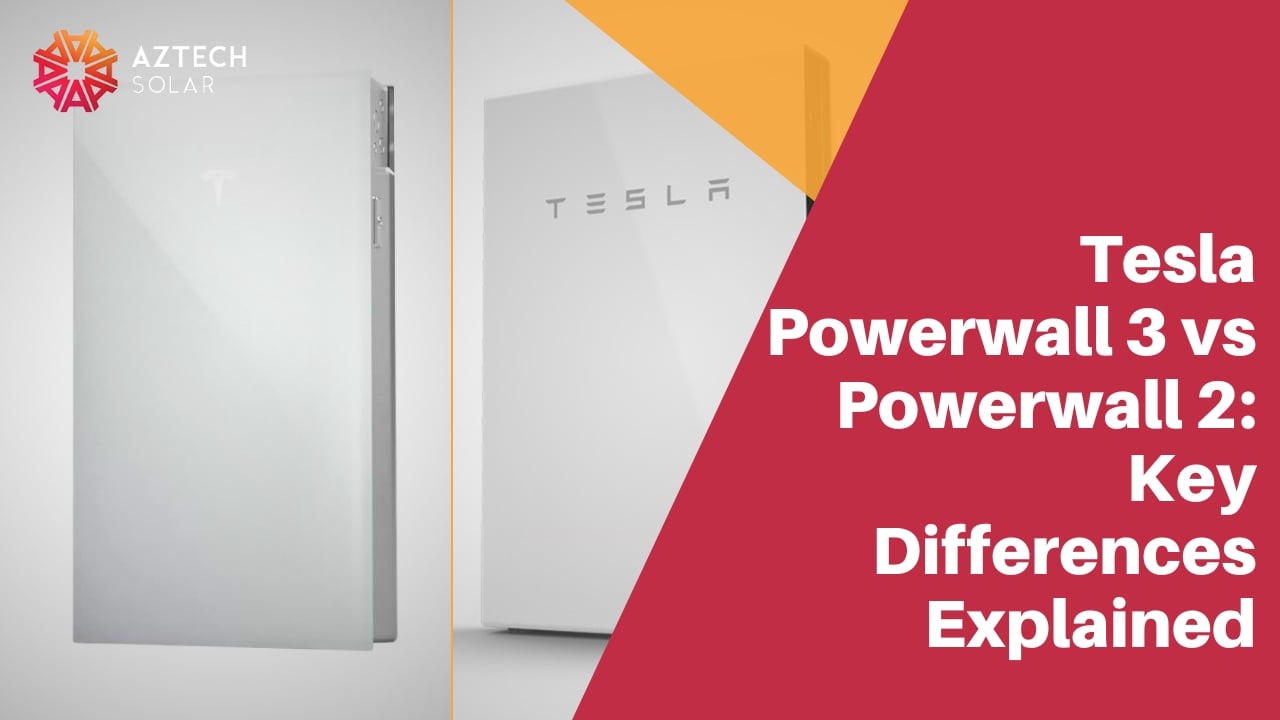
Both batteries hold the same 13.5 kWh of usable energy, so capacity isn’t where these two models part ways. The differences that matter are the inverter, the power output, and what you can add to the system later. Powerwall 3 has a solar inverter built into it and delivers more than double the continuous output of Powerwall 2. It’s also the only one of the two you can buy new in Australia, because Powerwall 2 has been discontinued here. If you’re comparing your options for a home battery system, or you already own a Powerwall 2 and want more storage, here’s what separates the two generations.
Capacity stayed the same, the way you scale it didn’t
Each unit holds 14 kWh total and 13.5 kWh usable, on both generations. Tesla measures that at 25 degrees, at beginning of life, so treat it as a best-case figure rather than what you’ll see on a 40-degree February afternoon.
Where they differ is how you add more. With Powerwall 2 you stacked more Powerwall 2 units, each a complete battery and inverter on the AC side of a Gateway.
Powerwall 3 gives you two paths. Up to four Powerwall 3 units, or one Powerwall 3 with up to three Powerwall 3 Expansion units behind it. An Expansion is battery only, 13.5 kWh, no inverter of its own, and it works with nothing except a Powerwall 3. One Powerwall 3 plus three Expansions gets you to 54 kWh, and costs less per kilowatt hour than stacking full units. Our Tesla Powerwall 3 product page covers the configurations we install.
The built-in inverter is the real change
Powerwall 2 is AC coupled. Your panels feed a separate solar inverter, that inverter turns DC into AC for the house, and anything heading into the battery gets converted back to DC on the way in. Two boxes on the wall, two sets of conversions.
Powerwall 3 has the solar inverter inside the battery. Panels connect straight to it on the DC side, up to 20 kW of solar at STC, across three MPPT channels with a 60 to 480 V DC tracking range. For a new install that’s one less unit to mount, wire and eventually replace.
The efficiency figures get misread constantly, so it’s worth being precise. Tesla quotes 97.5% for solar passing through Powerwall 3 to your home or the grid, and 89% for solar that goes into the battery and comes back out again. Powerwall 2’s published figure is a 90% round trip, measured AC to battery to AC.
Those measure different things. The claim you’ll see on plenty of comparison pages, that Powerwall 3 is seven or eight per cent more efficient, sets the 97.5% pass-through figure against the 90% round trip and compares nothing meaningful. On a true round trip through the battery the two sit within a percentage point of each other. Powerwall 3’s advantage is in the solar your house uses as it’s generated, because that energy never gets converted twice. There’s more in our rundown of Powerwall 3’s performance and features.
Backup power and starting heavy appliances
This is the widest gap between the two. Powerwall 2 does 5 kW continuous, charging or discharging, with a 7 kW peak for 10 seconds when it’s running off grid. Powerwall 3 comes in 5 kW, 10 kW and 11.04 kW output configurations, and 11.04 kW is the one usually installed in Australian homes.
The figure that decides whether backup feels usable is load start capability, quoted in locked rotor amps. That’s the surge a motor pulls in the instant it kicks over. Powerwall 2 is rated at 88 to 106 A LRA. Powerwall 3 is rated at 185 A.
In practice that’s the difference between a battery that can start a ducted air conditioning compressor, a pool pump or a bore pump during a blackout, and one that struggles to. If you’ve ever had a single Powerwall 2 trip when the aircon cycled on mid outage, that’s the number behind it.
Both use the same Backup Gateway 2 to disconnect from the grid and run the house. There is no Gateway 3. Both are single phase units, so on a three-phase home, backup runs on the phase they’re connected to.
Charging speed is the limit most comparisons skip
Powerwall 3 discharges at up to 11.04 kW, but it charges at no more than 5 kW, or 21.7 A AC. That’s the same charge rate as Powerwall 2. A 20 kW array on the roof won’t refill the battery any faster than a 6 kW one once you’re past that ceiling.
Tesla’s 2025 datasheet does list 8 kW charging for a Powerwall 3 running with Expansion units, but the footnote says it needs a future firmware version, and the current limit is still 5 kW. Worth knowing if someone quotes you the higher number.
Size, noise and where it can go
Powerwall 3 is shorter and noticeably narrower than Powerwall 2, but thicker and 16 kg heavier. Down a tight side passage that narrower footprint helps.
Noise is the one nobody mentions. Powerwall 2 sits under 40 dBA at a metre at 30 degrees. Powerwall 3 is quoted at under 50 dBA typical and up to 62 dBA maximum, because it has an inverter and cooling to run. Neither is loud, but 62 dBA is conversation volume, worth a thought before you mount one on the other side of a bedroom wall.
Both are rated for indoor or outdoor installation, with IP67 protection on the battery and electronics. Powerwall 3 derates above 40 degrees, Powerwall 2 below 10 or above 43. Across Newcastle and the Hunter, it’s the summer end of that range that matters, so shade and airflow count for more here than cold weather performance.
Monitoring and day to day use
Both run through the same Tesla app, with the same modes: self-powered, savings, and a backup reserve you set yourself. Day to day, nothing about operating the system changes between generations. Powerwall 3 does add connection options, taking Wi-Fi on 2.4 and 5 GHz, wired Ethernet or a 4G cellular fallback, with revenue grade internal metering at plus or minus 0.5%.
Side by side
Figures below come from Tesla’s current datasheets for both models.
| Specification | Powerwall 2 | Powerwall 3 |
| Usable energy per unit | 13.5 kWh | 13.5 kWh |
| Total energy per unit | 14 kWh | 14 kWh |
| Solar inverter | Separate unit needed | Built in, up to 20 kW solar at STC |
| Coupling | AC coupled | DC coupled solar |
| Continuous output | 5 kW | 5 kW, 10 kW or 11.04 kW depending on configuration |
| Load start capability | 88 to 106 A LRA | 185 A LRA |
| Maximum charge power | 5 kW | 5 kW |
| Efficiency | 90% round trip, AC to battery to AC | 97.5% solar to home or grid, 89% via the battery |
| Scaling | Add more Powerwall 2 units | Up to 4 units, or 1 unit with up to 3 Expansions |
| Dimensions | 1150 x 753 x 147 mm | 1105 x 609 x 193 mm |
| Weight | 114 kg | 130 kg |
| Noise at 1 m | Under 40 dBA at 30 degrees | Under 50 dBA typical, 62 dBA maximum |
| Gateway | Backup Gateway 2 | Backup Gateway 2 |
| Warranty | 10 years | 10 years |
| Sold new in Australia | No, discontinued | Yes |
What Powerwall 2 owners can do now
This is the part that changed recently, and it’s why the comparison still matters if you already own a battery. Tesla has switched on backwards compatibility between the generations, Australia and New Zealand first. A Powerwall 3 can now be added alongside an existing Powerwall 2, and the two run as one system. Tesla’s backwards compatibility page sets out the detail:
- Your Powerwall 2 needs to be on software version 26.26 or later.
- Supported setups run up to four Powerwall 2 units with one Powerwall 3 and up to three Powerwall 3 Expansion units.
- It’s a software change. There’s no rewiring or hardware swap on the Powerwall 2 itself.
- On a three-phase connection, the Powerwall 3’s output is capped at 5 kW in a mixed system.
- Gateway 1 and the Neurio meter aren’t supported, so older installs need assessing first.
- Powerwall 2 keeps its original warranty. The Powerwall 3 and any Expansions carry their own 10 years.
- Only the Powerwall 3 needs a current CEC listing. Your existing Powerwall 2 stays compliant.
Tesla requires the work to be done by a Tesla Certified Installer. New Powerwall 3 and Expansion units may also qualify for a discount under the federal Cheaper Home Batteries Program, worth checking alongside the other rebates available to Australian households before you commit to anything.
Powerwall 2 is discontinued, and some units are under recall
Powerwall 2 is no longer sold new in Australia and no longer appears on the Clean Energy Council’s approved batteries list, which rules it out of the battery discount. For a new installation, then, there’s no live choice to make between the two.
There’s also an active recall. Tesla identified lithium-ion cells from a third-party supplier in a subset of Powerwall 2 systems that may fail and overheat, with reports of units smoking or emitting flames and some property damage. Most affected units have been discharged remotely and are being replaced at no cost. If you own a Powerwall 2, check it’s online and look for a notification in the Tesla app. The full notice sits on the ACCC Product Safety recall page, last updated in April 2026 to widen the range of sale dates covered. Powerwall 3 isn’t affected.
Which home battery system makes sense now
For a first battery, the Powerwall 3 against Powerwall 2 question is settled by availability rather than specifications. The comparison worth having is Powerwall 3 against the other batteries on the market, which comes down to your usage pattern, your roof, your phase configuration and your budget.
If you already own a Powerwall 2, the sensible move is usually to keep it and expand rather than replace a battery that’s still doing its job. Adding storage pays off when you’re regularly running flat before morning. If you finish most nights with charge to spare, you don’t need more yet. Have a look through the home battery systems we install to see how Powerwall 3 sits against the alternatives.
For a straight answer on what suits your place, book a free onsite quote with Aztech Solar or call the team on 1300 992 922. We’ll check your existing setup, switchboard and phase configuration before recommending anything.
Can I add a Powerwall 3 to my existing Powerwall 2?
Yes, in Australia. Your Powerwall 2 needs software version 26.26 or later, and the work must be done by a Tesla Certified Installer. Gateway 1 and Neurio meter installations need checking first.
Is Powerwall 3 more efficient than Powerwall 2?
For solar your house uses immediately, yes, because there’s no double conversion. On a full round trip through the battery the two are close, at 89% for Powerwall 3 and 90% for Powerwall 2.