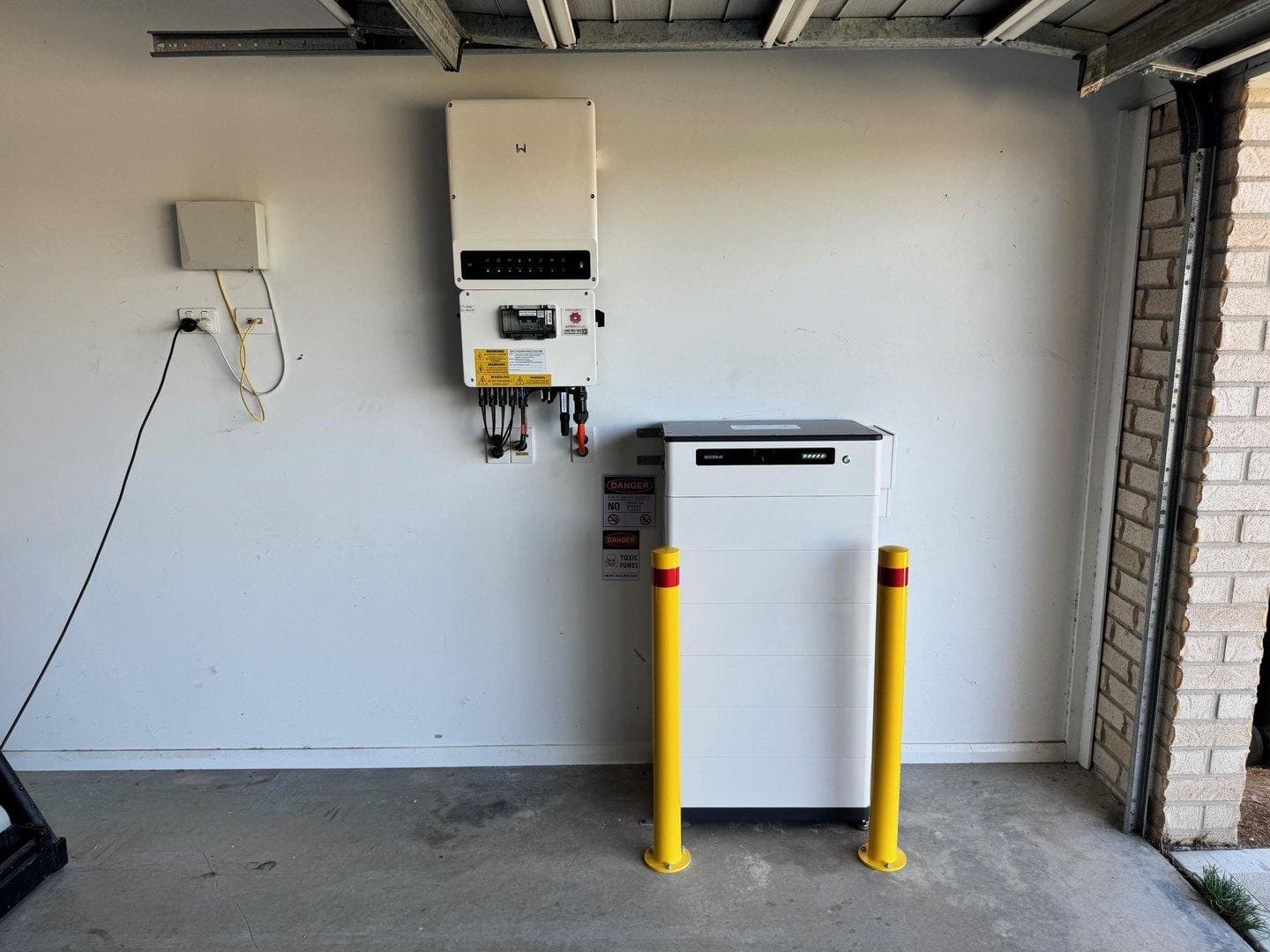
Most solar inverters can’t take a battery. If your system went in as a solar-only package, odds are you’ve got a string inverter with no battery connection at all. You can check this yourself in about two minutes. Walk out to the inverter, read the model number off the front, and look at the letters. On a Sungrow, SH means hybrid and battery ready. SG means solar only. That one letter decides whether adding a battery costs you a few thousand dollars more than you expected.
A hybrid inverter is a single unit that runs your panels, your battery and your grid connection through one box, with a dedicated battery port on it. A string inverter converts panel output to AC for the house and has no battery port. Both are common on Australian roofs. Only one of them takes a battery directly.
How do you tell if your inverter is battery ready?
Read the model number on the front of the inverter and check the letters in it. Manufacturers use naming patterns to separate hybrid models from solar-only ones. Sungrow uses SH for hybrid and SG for string. If the datasheet for your exact model doesn’t list a battery port, the inverter can’t take one.
The inverter is usually on a garage wall, in a laundry, or mounted outside near the meter box. The model number sits on a label on the front or the side, printed alongside the serial number. Take a photo of it. It’s the most useful thing you can send an installer when you ask for a battery quote.
Here’s the pattern across the brands we see most in Newcastle and the Hunter.
| Brand | Solar only (string) | Battery ready (hybrid) |
| Sungrow | SG series | SH series |
| Fronius | Primo, Symo | Primo GEN24 Plus, Symo GEN24 Plus |
| GoodWe | DNS series | ES, EH and ESA series |
| SolarEdge | Any model with an LCD screen on the front | Energy Hub and Home Hub. Genesis and HD-Wave also take a battery if they run on SetApp. |
Phase matters as much as the letters. Sungrow’s single-phase hybrids are the SH-RS models, and the three-phase units are SH-RT and SH-T. If you’re not sure which supply you’ve got, your main switch or your power bill will tell you.
Two brands have a middle option worth knowing about. A Fronius GEN24 without the Plus suffix has the battery hardware inside it but the function switched off, and Fronius sells a software upgrade that turns it on. GoodWe’s EH series ships as a grid-tied inverter and needs an activation code to run as a hybrid. If either of those is on your wall, you might not need new hardware at all.
SolarEdge breaks the pattern, so check it a different way. Several families share the same model number, so the full part number is the only reliable tell. The quicker test is the screen. SolarEdge’s battery documentation says the Home Battery only works with inverters commissioned through the SetApp app, which are the ones with no LCD display. If your SolarEdge inverter has a screen on the front, it can’t take the battery and there is no upgrade kit. If it has no screen, it most likely can, though full home backup needs an Energy Hub or Home Hub plus a backup interface.
What if your inverter isn’t battery ready?
You’ve got two paths. Replace the inverter with a hybrid model and run a DC coupled battery through it, or keep the inverter you have and add an AC coupled battery that brings its own inverter with it. Both are standard practice. Which one is cheaper comes down to how old your current inverter is.
DC coupling means replacing the inverter
DC coupled is a battery that wires into the direct current side of the system, through a port on a hybrid inverter. Swapping a string inverter for a hybrid runs roughly $2,500 to $3,500 for the unit and the labour, and that sits on top of the battery price.
On Sungrow, the SBR and SBH batteries are DC coupled and connect to the battery port on an SH inverter. They won’t connect to an SG. Sungrow’s own approved battery declaration goes further than that: its SH hybrids support Sungrow SBR and SBH high voltage batteries and nothing else, so a third party battery isn’t an option once you’re on that platform.
If you already have a SolarEdge system, SolarEdge supplies a replacement Home Hub inverter at no cost when you add its battery and backup interface to an existing site. Your installer claims it, and it runs to 31 December 2026.
AC coupling means keeping the inverter you’ve got
AC coupled is a battery with its own inverter built in, wired into your switchboard on the AC side. It doesn’t care what brand your existing inverter is or how old it is, and nobody touches your rooftop wiring.
The Enphase IQ Battery 5P and the Tesla Powerwall 3 both work this way, which is why they turn up so often on retrofit quotes. The trade-off is conversion losses. Solar comes off the roof as DC, your inverter turns it into AC, the battery turns it back into DC to store it, then back to AC again to run the house. Round trip efficiency lands a few per cent lower than a DC coupled setup.
AC coupled or DC coupled, which one wins?
AC coupling usually wins on a retrofit because it skips the inverter replacement entirely. DC coupling wins when your existing inverter is near the end of its life anyway, or when you’re putting solar and a battery in together. The efficiency gap is real, but it’s small next to a $3,000 hardware cost.
| DC coupled | AC coupled | |
| Your existing inverter | Replaced with a hybrid | Stays where it is |
| Extra inverter cost | About $2,500 to $3,500 | None |
| Battery brand choice | Limited to what the hybrid supports | Works with any inverter |
| Round trip efficiency | Higher, one conversion | Slightly lower, two conversions |
| Best suited to | New solar and battery together, or an ageing inverter | An inverter with years left in it |
Here’s the rough rule we use on site. If your inverter is under about seven years old and running clean, AC coupling is almost always the cheaper answer. If it’s past ten, or it’s been throwing faults, you’re looking at replacing it inside a couple of years regardless, so put a hybrid in now and go DC coupled.
Inverters typically last 10 to 15 years against 25 years for panels, so most solar owners land on this decision eventually. It’s the same calculation that comes up when you’re expanding an existing solar system.
Which battery ready inverters do we install?
Sungrow SH series hybrids paired with SBR or SBH batteries are the most common DC coupled setup we put in, and Sungrow is the most widely installed inverter brand in the country. You can read more about our Sungrow hybrid inverters. For AC coupled retrofits we use Enphase, where the battery pairs with whatever system is already there. GoodWe and Fronius hybrids are both on our range as well.
What suits you depends on what’s already on your wall and how much storage you’re after. Our inverter range and solar battery storage pages cover the options.
What do the rebate changes mean for timing?
The federal Cheaper Home Batteries Program takes around 30 per cent off an installed battery, applied by your installer at the point of sale. The STC factor behind it sits at 6.8 per usable kWh until 31 December 2026, then steps down again. It now drops every six months instead of once a year.
Eligibility is broad. Batteries from 5 kWh to 100 kWh nominal capacity qualify, certificates are paid on the first 50 kWh of usable capacity, and there’s no income test. The battery has to go in alongside solar, and existing solar counts. We’ve covered the federal battery rebate in more detail separately.
Take a Hunter household adding a 10 kWh battery before the end of December:
- 10 kWh of usable capacity multiplied by 6.8 gives 68 certificates
- At a market STC price around $37, that’s roughly $2,500 off the installed price
- Every kWh earns the full rate, because the battery sits under 14 kWh
Above 14 kWh the rate tapers. You get the full factor on the first 14 kWh, 60 per cent on anything between 14 and 28 kWh, and 15 per cent from 28 to 50 kWh. A 20 kWh battery earns full certificates on 14 kWh and 60 per cent on the other six. Nothing above 50 kWh earns certificates at all.
One thing the rebate doesn’t cover is the inverter. If you need a hybrid swap to go DC coupled, that $2,500 to $3,500 comes out of your pocket in full. For plenty of Hunter homes with a healthy string inverter, that fact settles the decision in favour of AC coupling.
Frequently asked questions
Does adding a battery need network approval?
Yes. Your installer has to notify the network operator, which is Ausgrid across Newcastle and the Hunter, and have the connection approved before the battery is commissioned. It’s handled as part of the job, but it does add time to the schedule.
Can I add a battery if I have microinverters?
Yes, and it’s one of the easier retrofits. Microinverter systems like Enphase are AC coupled by design, so a battery wires into the switchboard without anyone going on the roof.
Will adding a battery affect my existing warranties?
Your panel warranty is separate from your inverter and stays intact either way. Replacing a string inverter does end any remaining warranty on that unit, which is worth checking before you swap it. If your inverter is three years into a ten-year warranty, AC coupling keeps that cover alive.
Do I need to replace my panels as well?
No. Panels are usually warranted for 25 years, and most systems from the last decade are still producing well within their performance warranty. A battery doesn’t care how old your panels are.
Find out where you stand
Send us a photo of your inverter label and we’ll tell you whether it’ll take a battery, and what each path would cost on your system. Request a quote or call 1300 992 922.